
'%3e%3cpath%20d='M25.8906%2030.68L16.0006%2025L6.14062%2030.68V4.55C6.14063%203.75435%206.4567%202.99129%207.0193%202.42868C7.58191%201.86607%208.34498%201.55%209.14063%201.55H22.8906C23.6863%201.55%2024.4493%201.86607%2025.0119%202.42868C25.5746%202.99129%2025.8906%203.75435%2025.8906%204.55V30.68ZM9.14063%203.55C8.87541%203.55%208.62105%203.65536%208.43352%203.84289C8.24598%204.03043%208.14063%204.28478%208.14063%204.55V27.23L16.0006%2022.72L23.8806%2027.23V4.55C23.8806%204.28478%2023.7753%204.03043%2023.5877%203.84289C23.4002%203.65536%2023.1458%203.55%2022.8806%203.55H9.14063Z'%20fill='white'/%3e%3cpath%20d='M9.14063%202.55H22.8906C23.4211%202.55%2023.9298%202.76071%2024.3048%203.13579C24.6799%203.51086%2024.8906%204.01957%2024.8906%204.55V8.62H7.14062V4.55C7.14063%204.01957%207.35134%203.51086%207.72641%203.13579C8.10148%202.76071%208.61019%202.55%209.14063%202.55Z'%20fill='%238A3301'/%3e%3cpath%20d='M25.8906%209.62H6.14062V4.55C6.14063%203.75435%206.4567%202.99129%207.0193%202.42868C7.58191%201.86607%208.34498%201.55%209.14063%201.55H22.8906C23.6863%201.55%2024.4493%201.86607%2025.0119%202.42868C25.5746%202.99129%2025.8906%203.75435%2025.8906%204.55V9.62ZM8.14063%207.62H23.8906V4.55C23.8906%204.28478%2023.7853%204.03043%2023.5977%203.84289C23.4102%203.65536%2023.1558%203.55%2022.8906%203.55H9.14063C8.87541%203.55%208.62105%203.65536%208.43352%203.84289C8.24598%204.03043%208.14063%204.28478%208.14063%204.55V7.62Z'%20fill='white'/%3e%3cpath%20d='M16%2020.25C15.7348%2020.25%2015.4804%2020.1446%2015.2929%2019.9571C15.1054%2019.7696%2015%2019.5152%2015%2019.25V14.07C15%2013.8048%2015.1054%2013.5504%2015.2929%2013.3629C15.4804%2013.1754%2015.7348%2013.07%2016%2013.07C16.2652%2013.07%2016.5196%2013.1754%2016.7071%2013.3629C16.8946%2013.5504%2017%2013.8048%2017%2014.07V19.25C17%2019.5152%2016.8946%2019.7696%2016.7071%2019.9571C16.5196%2020.1446%2016.2652%2020.25%2016%2020.25Z'%20fill='white'/%3e%3cpath%20d='M18.5999%2017.66H13.4199C13.1547%2017.66%2012.9004%2017.5546%2012.7128%2017.3671C12.5253%2017.1796%2012.4199%2016.9252%2012.4199%2016.66C12.4199%2016.3948%2012.5253%2016.1404%2012.7128%2015.9529C12.9004%2015.7654%2013.1547%2015.66%2013.4199%2015.66H18.5999C18.8651%2015.66%2019.1195%2015.7654%2019.307%2015.9529C19.4946%2016.1404%2019.5999%2016.3948%2019.5999%2016.66C19.5999%2016.9252%2019.4946%2017.1796%2019.307%2017.3671C19.1195%2017.5546%2018.8651%2017.66%2018.5999%2017.66Z'%20fill='white'/%3e%3c/g%3e%3cdefs%3e%3cclipPath%20id='clip0_29353_35'%3e%3crect%20width='32'%20height='32'%20fill='white'/%3e%3c/clipPath%3e%3c/defs%3e%3c/svg%3e) Wishlist
Wishlist
There is a pretty big gap between a fast rimfire and a traditional centerfire rifle cartridge.
The 17 HMR is light recoiling, accurate and impressively fast for a rimfire. The .223 Remington brings considerably more power, heavier bullets and greater capability as distances stretch. But what if you want something in between?
That's where the 17 Hornet gets interesting.
Hornady's 20 grain V MAX factory load leaves a 24 inch test barrel at a listed 3,650 fps. That's serious centerfire velocity coming from a cartridge based on the tiny .22 Hornet case. Yet the 17 Hornet produces very little recoil, doesn't require much powder, and can deliver a remarkably flat trajectory at practical varmint shooting distances. Hornady's published data puts that same 20 grain load at 3,077 fps at 100 yards and 2,574 fps at 200.
It isn't a replacement for everything above or below it. Those tiny bullets have limitations, particularly as wind and distance increase.
But that might be exactly what makes the 17 Hornet so interesting.
It doesn't really try to replace the 17 HMR or .223 Remington.
It fills the space between them.
Quick Answer: What Is the 17 Hornet Good At?
The 17 Hornet is a small centerfire rifle cartridge primarily suited to varmint and small predator shooting. Its biggest attractions are high velocity, flat trajectory, very mild recoil and excellent accuracy potential without requiring the larger case capacity of cartridges such as .223 Remington.
The cartridge commonly uses extremely light .172 inch bullets, with 20 grain projectiles being especially common. Hornady lists its 20 grain V MAX load at 3,650 fps and 592 ft lb of muzzle energy.
That puts it well beyond the velocity of the familiar 17 HMR. For comparison, Hornady lists a 20 grain 17 HMR load at 2,375 fps.
But there's an important distinction beyond the numbers.
The 17 HMR is a rimfire.
The 17 Hornet is a reloadable centerfire cartridge.
It offers a substantial step up in velocity while retaining much of the light shooting personality that makes small rimfires enjoyable. Move up to .223 Remington and you gain heavier bullets and considerably more capability, but you're also moving into a different class of cartridge.
That's the little niche the 17 Hornet has carved out for itself.
The 17 Hornet Idea Is Much Older Than You Might Think
The modern 17 Hornet may seem like one of the newer small caliber centerfires, but the idea behind it goes back decades.
Experimenters were working with tiny .17 caliber centerfire cartridges as far back as the early 1950s. P.O. Ackley, one of the most famous names in wildcat cartridge development, experimented with necking down cartridges including the .22 Hornet to accept .172 inch bullets.
His .17 Ackley Hornet established the basic concept long before shooters could walk into a store and buy factory 17 Hornet ammunition.
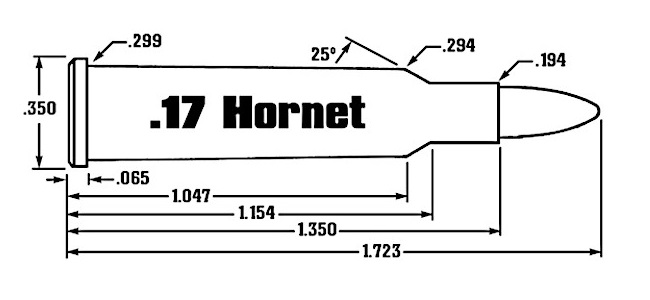
The Ackley version and today's Hornady cartridge are not identical. Ackley's design used a 30 degree shoulder, while Hornady's modern version uses a 25 degree shoulder along with other dimensional differences.
But the basic idea survived: take the small .22 Hornet case, neck it down for a tiny .17 caliber projectile and see just how much performance you can squeeze out of it.
Hornady eventually turned the concept into a standardized factory cartridge, receiving SAAMI approval for the 17 Hornet in 2012.
More than half a century separated Ackley's experiments from the standardized Hornady cartridge.
The reason the idea came back is pretty easy to understand once you look at the ballistics.
A 20 Grain Bullet at 3,650 FPS
This is the number that defines the 17 Hornet for a lot of shooters.
3,650 fps.
Hornady gets that advertised muzzle velocity from a 20 grain V MAX projectile fired from a 24 inch test barrel. Muzzle energy is listed at 592 ft lb.
For such a small cartridge, that's moving.
But the more interesting part is what happens after the bullet leaves the barrel.
Hornady lists the 20 grain V MAX at 3,077 fps at 100 yards and 2,574 fps at 200 yards. With the trajectory data based around a 200 yard zero, the bullet is 1.1 inches high at 100 yards, dead on at 200 and 6.4 inches low at 300.
That's why the 17 Hornet earned a reputation for being such a flat shooting little cartridge.
At the distances where it makes the most sense, there isn't a huge amount of trajectory correction required.
And it does all of this with a projectile weighing only 20 grains.
Don't Expect Every Rifle to Produce Exactly 3,650 FPS
Published velocity is useful for comparing ammunition, but it shouldn't be treated as a guarantee.
Barrel length, chamber dimensions, temperature, ammunition lot and the individual rifle can all affect actual velocity. Hornady's 3,650 fps figure comes from controlled testing with a 24 inch barrel.
That means your rifle might be faster.
It might be slower.
This matters when discussing cartridges such as the 17 Hornet because velocity is such a major part of their appeal. A number printed on an ammunition box is a useful reference point, but actual performance should always be verified from the rifle you're shooting.
The same principle applies to accuracy.
Two rifles chambered for the same cartridge don't necessarily prefer the same ammunition.
Your rifle still gets a vote.
Why 20 Grain Bullets Fit the 17 Hornet So Well
The 17 Hornet isn't a cartridge with a gigantic bullet weight range.
That's actually part of its charm.
Instead of trying to make the cartridge perform completely different jobs through radically different bullet weights, most factory 17 Hornet ammunition stays focused on lightweight projectiles and high velocity.
The 20 grain class has become particularly representative of the cartridge.
A 20 grain projectile is light enough to achieve the velocity that makes the 17 Hornet special, while still offering useful downrange performance for the small targets and varmints the cartridge was designed around.
There have also been other factory weights. American Hunter notes that Hornady has offered a lighter 15.5 grain load, while 25 grain projectiles have also been used in the cartridge.
The lighter side pushes velocity even further. American Hunter lists Hornady's 15.5 grain NTX load at 3,870 fps.
But chasing the highest velocity number isn't necessarily the point.
A bullet's construction, ballistic coefficient and intended purpose matter alongside its weight.
For many shooters, the 20 grain class represents a particularly good demonstration of what the 17 Hornet was created to do.
17 Hornet vs 17 HMR: This Is a Real Step Up
The comparison with 17 HMR is unavoidable because both cartridges fire tiny .17 caliber bullets and can fill similar roles.
But they're very different cartridges.
The 17 HMR is based on the .22 Magnum rimfire case and commonly launches bullets between approximately 15.5 and 20 grains. American Hunter lists typical 17 grain HMR loads between about 2,530 and 2,650 fps, while 20 grain loads run around 2,375 fps.
The 17 Hornet takes a 20 grain bullet to approximately 3,650 fps.
That's more than 1,200 fps faster than the 2,375 fps 20 grain HMR example.
That's not a subtle difference.
The Hornet's higher velocity produces a flatter trajectory and substantially more energy at the muzzle. It also extends the useful performance envelope beyond what most shooters expect from a rimfire.
But that doesn't make the 17 HMR obsolete.
The HMR remains a wonderfully mild and convenient rimfire cartridge. If your shooting doesn't require the extra performance of the Hornet, there's no reason you automatically need to move up.
The 17 Hornet simply gives shooters who like the basic idea of the 17 HMR somewhere to go when they want more velocity and centerfire performance without making the much bigger jump to a conventional centerfire such as .223 Remington.
So Why Not Just Shoot .223?
That's probably the most important question in this entire article.
The .223 Remington is enormously popular. Ammunition and rifles are widely available, bullet selection is far broader, and it can launch much heavier projectiles than the 17 Hornet.
If you need the capabilities of .223, the 17 Hornet isn't going to magically replace it.
But not everybody needs those capabilities.
A major appeal of the Hornet is getting enough performance for its intended role while keeping everything else small.
The case is tiny.
Powder consumption is relatively low.
Recoil is extremely mild.
The report is still that of a centerfire rifle, but you're not burning the amount of powder associated with larger high velocity cartridges.
And for small targets at moderate distances, a 20 grain projectile moving at 3,650 fps can deliver the trajectory a shooter wants without requiring a larger cartridge.
American Hunter describes the felt recoil as little more than a .22 WMR and specifically highlights the cartridge for extended shooting sessions.
That's an important part of the Hornet's appeal.
It isn't about beating .223.
It's about asking whether you actually need .223 for the shooting you're doing.
The Wind Is Where the Tiny Bullet Pays the Price
So far the 17 Hornet sounds almost too good.
Tiny case.
Very little recoil.
3,650 fps.
Flat trajectory.
There has to be a catch.
There is.
The bullet only weighs about 20 grains.
High initial velocity can't make that fact disappear.
Lightweight bullets are more vulnerable to wind than heavier projectiles with favorable ballistic characteristics, and that becomes increasingly important as distance grows.
American Hunter compared the 17 Hornet with a 55 grain .223 Remington load and found that at extended distance, the Hornet required considerably more wind correction.
This is where looking only at trajectory can fool you.
Vertical drop is only one part of long distance shooting.
A cartridge can produce an impressively flat trajectory in calm conditions while still becoming challenging when a crosswind starts pushing that tiny projectile sideways.
That's why we wouldn't describe the 17 Hornet as a miniature .223.
The Hornet can produce surprisingly similar looking trajectory numbers in certain comparisons, but it does so with a projectile weighing a fraction as much.
Physics eventually catches up.
It Loses Energy Quickly Too
The same issue appears when we look at retained energy.
Hornady's 20 grain V MAX starts with 592 ft lb at the muzzle. At 100 yards it carries 420 ft lb, and at 200 yards that figure has fallen to 294 ft lb. By 300 yards, it's down to 200 ft lb.
Keep going and the numbers fall quickly.
At 400 yards Hornady lists 132 ft lb, and at 500 yards only 85 ft lb remains.
That doesn't make the cartridge bad.
It tells you what it is.
The 17 Hornet gets its impressive performance from velocity rather than projectile mass. As that velocity disappears, there isn't a heavy bullet carrying large amounts of energy downrange.
That's another reason its sweet spot is much closer to the varmint and small predator world than the general purpose centerfire rifle category.
Where the 17 Hornet Really Shines
Put the cartridge back into the environment it was designed for and its characteristics make much more sense.
Small targets reward accuracy.
Moderate distances reward a flat trajectory.
High volume shooting rewards mild recoil.
Varmint bullets benefit from high velocity.
And if you're sitting behind a rifle for an extended shooting session, the difference between a tiny centerfire and a much larger cartridge becomes noticeable.
That's where the 17 Hornet starts looking less like an oddball and more like a very carefully focused tool.
American Hunter has highlighted the cartridge for varmints and predators, including applications where rapidly expanding bullets and minimal recoil are useful.
It isn't trying to be a deer cartridge.
It isn't trying to be a long range competition cartridge.
It isn't trying to replace .223 for every possible purpose.
It does something much narrower.
And it does that job remarkably well.
The 17 Hornet Is a Centerfire, and That Matters
One major distinction between 17 Hornet and cartridges such as 17 HMR is easy to overlook.
The Hornet is reloadable.
For someone who never intends to reload ammunition, that may not matter at all.
For handloaders, it's a significant difference.
A centerfire case can be resized, reprimed and loaded again, allowing experienced reloaders to experiment with different projectiles and loads within published data and component manufacturer guidance.
The rimfire 17 HMR doesn't offer that flexibility.
That makes the 17 Hornet especially interesting to shooters who enjoy small caliber cartridges and handloading. It provides much of the light shooting personality associated with the tiny .17s while giving the shooter the flexibility of a conventional centerfire case.
Of course, you don't need to reload to enjoy the cartridge.
Factory ammunition is available.
But compared with something as mainstream as .223 Remington, factory 17 Hornet selection is considerably narrower. That's worth considering before buying a rifle chambered for it.
What Kind of Rifles Shoot 17 Hornet?
The cartridge has primarily found a home in bolt action varmint rifles.
Over the years, rifles chambered for 17 Hornet have included models such as the Savage Model 25, CZ 527 and Ruger 77/17. Gun Tests evaluated both the CZ 527 Varmint and Ruger 77/17 with 24 inch barrels and found the little cartridge easy to shoot and capable of impressive accuracy.
The CZ in particular produced five shot groups between roughly half an inch and eight tenths of an inch at 100 yards during that test.
That doesn't mean every 17 Hornet rifle will shoot groups like that.
But it reinforces an important point.
This cartridge isn't interesting solely because somebody figured out how to make a chronograph display a big number.
Accuracy is a major part of the appeal.
A tiny, high velocity cartridge makes much more sense when the rifle can consistently put those little bullets where they're supposed to go.
Is the 17 Hornet Loud?
This is one area where expectations need to be realistic.
The cartridge may be tiny and recoil may be extremely mild, but 17 Hornet is still a high velocity centerfire rifle cartridge.
Don't confuse low recoil with low noise.
It isn't a rimfire simply because it feels gentle from the shoulder.
That distinction matters because the Hornet can sometimes be discussed almost like a more powerful HMR. From a shooting experience standpoint, there are similarities, particularly the low recoil and small projectile.
But you're still dealing with a centerfire cartridge operating at substantially higher velocity.
Appropriate hearing protection remains essential.
Is 17 Hornet Expensive to Shoot?
Rather than quoting ammunition prices that could be outdated by the time you read this, it's more useful to look at the cartridge structurally.
17 Hornet uses a small case and relatively little propellant compared with larger centerfire cartridges. For handloaders, that can be attractive.
Factory ammunition is a different story.
The 17 Hornet doesn't have anything close to the enormous production volume or variety of .223 Remington. It also doesn't have the simplicity of buying mass produced rimfire ammunition such as 17 HMR.
Availability can vary, and there simply aren't as many loads to choose from.
That's one of the tradeoffs of choosing a specialized cartridge.
Before buying a 17 Hornet rifle, it's worth checking what ammunition is actually available to you and whether you're comfortable with that selection.
17 Hornet, 17 HMR or .223?
This is where we come back to the question in the title.
There isn't one universal winner because these cartridges aren't trying to solve exactly the same problem.
17 HMR makes a lot of sense when you want the simplicity, low recoil and convenience of a rimfire and don't need centerfire velocity.
17 Hornet becomes interesting when you want substantially more speed and reach than the HMR can provide, but still value a tiny cartridge, extremely mild recoil and light bullets.
.223 Remington makes more sense when you want a broader selection of bullet weights, much greater ammunition and rifle availability, and the additional capability that comes with a larger centerfire cartridge.
Seen that way, the 17 Hornet's position isn't confusing at all.
It's actually remarkably specific.
It sits right in the middle.
So, Is the 17 Hornet the Sweet Spot?
For the right shooter, it certainly can occupy one.
The 17 Hornet takes a concept wildcatters were experimenting with more than 70 years ago and turns it into a standardized little centerfire capable of launching a 20 grain bullet at around 3,650 fps.
That's enough speed to create an impressively flat trajectory at practical distances.
Recoil remains extremely mild.
Accuracy can be excellent.
The cartridge is reloadable.
And it provides a meaningful performance increase over 17 HMR without requiring the larger case and heavier bullets of .223 Remington.
But the Hornet doesn't get to break the laws of physics.
Its tiny bullets are affected by wind.
Energy falls quickly as distance increases.
Factory ammunition choices are limited compared with mainstream cartridges.
And if you need the broader capabilities of .223 Remington, the 17 Hornet isn't a substitute simply because its muzzle velocity looks impressive.
That's exactly why we like the "sweet spot" description.
The 17 Hornet isn't great because it replaces the cartridges on either side of it.
It's great because there's a surprisingly useful amount of room between them.
Information provided by AmmoBrowser is for general informational and educational purposes only. Ammunition specifications, ballistics, performance, pricing, and availability can vary by manufacturer, load, firearm, barrel length, and other conditions. While we strive to provide accurate and current information, AmmoBrowser makes no guarantee regarding its completeness or accuracy. Always follow firearm and ammunition manufacturer instructions, verify that ammunition is compatible with your firearm, and follow all applicable laws and safe firearm handling practices.