
'%3e%3cpath%20d='M25.8906%2030.68L16.0006%2025L6.14062%2030.68V4.55C6.14063%203.75435%206.4567%202.99129%207.0193%202.42868C7.58191%201.86607%208.34498%201.55%209.14063%201.55H22.8906C23.6863%201.55%2024.4493%201.86607%2025.0119%202.42868C25.5746%202.99129%2025.8906%203.75435%2025.8906%204.55V30.68ZM9.14063%203.55C8.87541%203.55%208.62105%203.65536%208.43352%203.84289C8.24598%204.03043%208.14063%204.28478%208.14063%204.55V27.23L16.0006%2022.72L23.8806%2027.23V4.55C23.8806%204.28478%2023.7753%204.03043%2023.5877%203.84289C23.4002%203.65536%2023.1458%203.55%2022.8806%203.55H9.14063Z'%20fill='white'/%3e%3cpath%20d='M9.14063%202.55H22.8906C23.4211%202.55%2023.9298%202.76071%2024.3048%203.13579C24.6799%203.51086%2024.8906%204.01957%2024.8906%204.55V8.62H7.14062V4.55C7.14063%204.01957%207.35134%203.51086%207.72641%203.13579C8.10148%202.76071%208.61019%202.55%209.14063%202.55Z'%20fill='%238A3301'/%3e%3cpath%20d='M25.8906%209.62H6.14062V4.55C6.14063%203.75435%206.4567%202.99129%207.0193%202.42868C7.58191%201.86607%208.34498%201.55%209.14063%201.55H22.8906C23.6863%201.55%2024.4493%201.86607%2025.0119%202.42868C25.5746%202.99129%2025.8906%203.75435%2025.8906%204.55V9.62ZM8.14063%207.62H23.8906V4.55C23.8906%204.28478%2023.7853%204.03043%2023.5977%203.84289C23.4102%203.65536%2023.1558%203.55%2022.8906%203.55H9.14063C8.87541%203.55%208.62105%203.65536%208.43352%203.84289C8.24598%204.03043%208.14063%204.28478%208.14063%204.55V7.62Z'%20fill='white'/%3e%3cpath%20d='M16%2020.25C15.7348%2020.25%2015.4804%2020.1446%2015.2929%2019.9571C15.1054%2019.7696%2015%2019.5152%2015%2019.25V14.07C15%2013.8048%2015.1054%2013.5504%2015.2929%2013.3629C15.4804%2013.1754%2015.7348%2013.07%2016%2013.07C16.2652%2013.07%2016.5196%2013.1754%2016.7071%2013.3629C16.8946%2013.5504%2017%2013.8048%2017%2014.07V19.25C17%2019.5152%2016.8946%2019.7696%2016.7071%2019.9571C16.5196%2020.1446%2016.2652%2020.25%2016%2020.25Z'%20fill='white'/%3e%3cpath%20d='M18.5999%2017.66H13.4199C13.1547%2017.66%2012.9004%2017.5546%2012.7128%2017.3671C12.5253%2017.1796%2012.4199%2016.9252%2012.4199%2016.66C12.4199%2016.3948%2012.5253%2016.1404%2012.7128%2015.9529C12.9004%2015.7654%2013.1547%2015.66%2013.4199%2015.66H18.5999C18.8651%2015.66%2019.1195%2015.7654%2019.307%2015.9529C19.4946%2016.1404%2019.5999%2016.3948%2019.5999%2016.66C19.5999%2016.9252%2019.4946%2017.1796%2019.307%2017.3671C19.1195%2017.5546%2018.8651%2017.66%2018.5999%2017.66Z'%20fill='white'/%3e%3c/g%3e%3cdefs%3e%3cclipPath%20id='clip0_29353_35'%3e%3crect%20width='32'%20height='32'%20fill='white'/%3e%3c/clipPath%3e%3c/defs%3e%3c/svg%3e) Wishlist
Wishlist
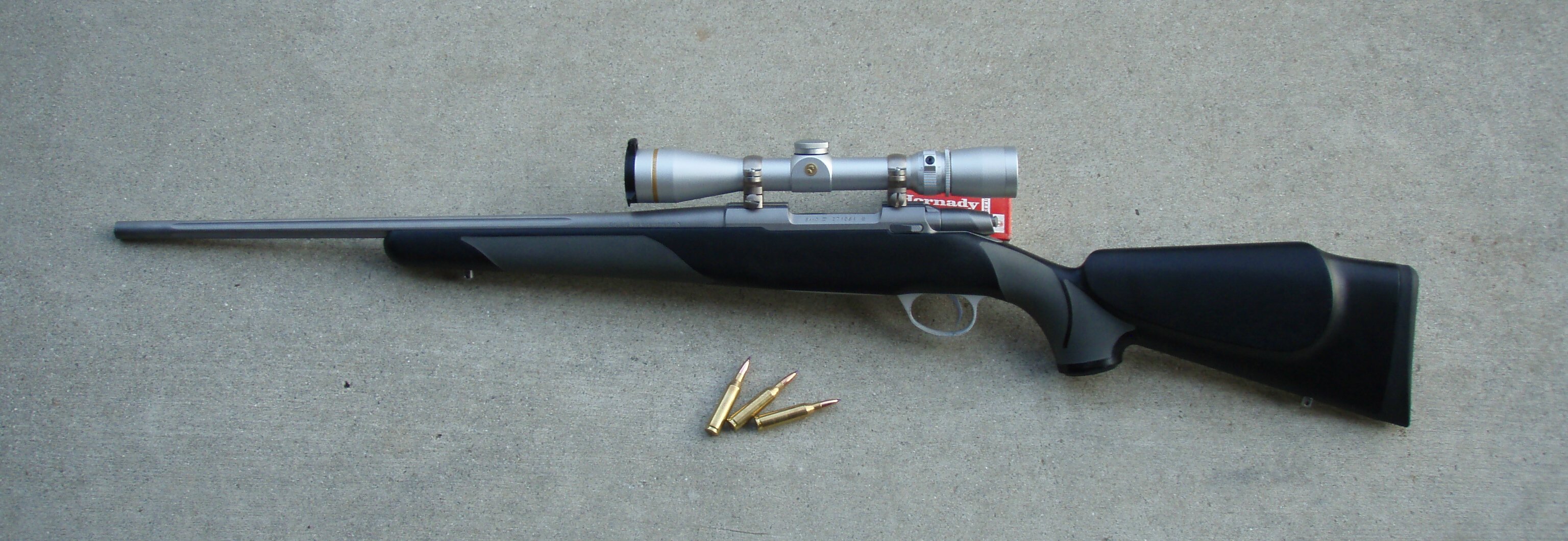
Some rifle cartridges are easy to understand. They have a relatively narrow range of bullet weights, a fairly obvious purpose, and most of the ammunition on the shelf is trying to accomplish roughly the same thing.
The .243 Winchester isn't one of them.
Pick up one box of .243 ammo and you might find a tiny 55 grain bullet capable of approaching 4,000 fps. Pick up another and there could be a 100 grain bullet moving closer to 3,000 fps. Between those extremes are 70, 75, 80, 85, 87, 90 and 95 grain loads built around everything from high velocity shooting to hunting.
They're all .243 Winchester.
That enormous range isn't some modern accident, either. Versatility was baked into the cartridge from the beginning. When Winchester introduced the .243 Winchester in 1955, the idea was essentially to create a cartridge capable of doing two very different jobs. Lighter bullets could provide the speed and trajectory varmint shooters wanted, while heavier bullets gave hunters a practical option for larger game such as deer.
Seventy years later, ammunition manufacturers have pushed that original idea much further.
And that's why choosing .243 ammo based only on the grain number printed on the box can be a mistake.
Quick Answer: What Makes .243 Winchester So Versatile?
The .243 Winchester combines high velocity, relatively mild recoil, a flat trajectory and an unusually broad selection of bullet weights in a short action rifle cartridge.
Modern factory ammunition ranges from extremely light bullets around 55 grains through conventional hunting bullets around 100 grains and beyond. That allows manufacturers to build very different loads around the same cartridge.
AmmunitionToGo lists examples ranging from a 55 grain Winchester Ballistic Silvertip at 3,910 fps to several 100 grain loads around 3,000 fps. Between them are dozens of combinations of weight, velocity and projectile construction.
That means there's no single answer to the question, "How does .243 Winchester perform?"
It depends heavily on what's loaded into it.
A 55 grain varmint bullet and a 100 grain hunting bullet may share the same cartridge case, but they're asking the .243 Winchester to do very different things.
The .243 Winchester Was Versatile From the Beginning
To understand why .243 ammunition varies so much, it helps to know why the cartridge exists.
Before Winchester introduced the factory cartridge, experimenters were already necking down the .308 Winchester case to accept smaller .243 inch bullets. Warren Page developed his .240 Page Super Pouper, while Fred Huntington developed the similar .243 Rockchucker.
Shooters had discovered an appealing combination.
The .308 case provided plenty of powder capacity, while the smaller .243 caliber projectile allowed considerably higher velocity with relatively modest recoil.
Winchester standardized the basic concept and introduced the .243 Winchester in 1955.
The really clever part was how the cartridge was positioned.
American Rifleman describes the original concept as using roughly an 80 grain bullet at around 3,200 fps for varmints, while bullets around 100 to 105 grains at approximately 3,000 fps gave the cartridge enough versatility for deer and antelope hunting.
In other words, Winchester wasn't trying to create a cartridge that did one thing exceptionally well.
The ability to change roles was the point.
Today's ammunition selection simply takes that original idea to an extreme.
From 55 to 100 Grains, .243 Ammo Covers a Huge Range
Walk through modern .243 Winchester ammunition and the number of available bullet weights can be surprising.
You'll encounter loads around 55, 58, 65, 70, 75, 80, 85, 87, 90, 95 and 100 grains, plus some heavier options.
But those numbers become much easier to understand if we divide them into three broad groups.
55 to 75 Grain: Speed Is the Headline
The light end is where .243 Winchester starts showing off.
AmmunitionToGo lists Winchester's 55 grain Ballistic Silvertip at 3,910 fps from a 24 inch barrel. Its data also includes a Hornady 75 grain V MAX at 3,580 fps.
Those are extremely high velocities for a conventional centerfire rifle cartridge.
Light bullets can produce a very flat initial trajectory because they're leaving the muzzle so quickly. Manufacturers commonly pair these lighter weights with projectile designs intended for varmints and similar applications where rapid expansion is desirable.
But this is our first reminder that bullet weight doesn't tell you everything.
Two 70 grain bullets can be constructed differently and intended for different purposes. The grain number tells you how much the projectile weighs. It doesn't tell you how the bullet will behave when it reaches its target.
Still, if you're looking at the lightest end of the .243 ammunition shelf, speed is usually a major part of the story.
And approaching 4,000 fps from a 55 grain factory load certainly gets your attention.
80 to 90 Grain: Where .243 Gets Really Interesting
The middle of the .243 Winchester range might be the most interesting part of the entire cartridge.
Here you'll find enough bullet weight to support a variety of hunting projectile designs while still retaining the high velocity that makes .243 Winchester attractive in the first place.
Factory ammunition commonly appears around 80, 85, 87 and 90 grains.
This is also where simplistic advice starts falling apart.
It's tempting to say light .243 bullets are for varmints and heavy bullets are for deer, with some magic dividing line somewhere in the middle.
Modern ammunition doesn't work that neatly.
An 80 grain bullet designed for rapid fragmentation is a very different projectile from an 80 grain monolithic copper hunting bullet designed around controlled expansion and penetration.
They weigh exactly the same.
They aren't trying to do the same thing.
Copper bullets make the comparison even more interesting. Copper is less dense than lead, which means a copper projectile can be physically longer than a traditional lead core bullet of the same weight. That can influence how the bullet interacts with the rifle's barrel twist and changes the assumption that a heavier number automatically means a longer or more demanding projectile.
That's why the middle weights deserve more attention than simply asking whether 80 grains is "better" than 100.
What the bullet is made to do matters as much as what it weighs.
95 to 100+ Grain: The Traditional Heavy Side of .243
Move toward 95 and 100 grains and you're entering the traditional heavier side of .243 Winchester ammunition.
The 100 grain bullet has been associated with the cartridge since its early years, particularly in ammunition intended for larger game.
AmmunitionToGo's ballistic data shows several 100 grain factory loads with muzzle velocities clustered around 2,960 to 3,110 fps, depending on the manufacturer and load. Its 90 grain Hornady ELD X example is listed at 3,150 fps.
Compare that with the 55 grain load at 3,910 fps and you can see how much personality the cartridge loses and gains as bullet weight changes.
The heavier bullet gives up substantial muzzle velocity.
But that doesn't mean it simply becomes a "worse" version of the lighter load.
Heavier bullets can offer different ballistic coefficients, momentum and projectile construction. A bullet designed for controlled expansion may also behave very differently on impact than a lightweight projectile designed for rapid expansion.
That's the tradeoff.
The light bullet wins the muzzle velocity contest.
The heavier bullet isn't necessarily trying to win that contest.
80 Grain vs 100 Grain: Which Should You Choose?
This is where a lot of .243 Winchester discussions eventually end up.
Should you shoot 80 grain or 100 grain ammunition?
The frustrating answer is also the useful one:
It depends on the bullet and your rifle.
A specific Federal example discussed by shooters on The Stalking Directory listed an 80 grain .243 load around 3,350 fps compared with roughly 2,960 fps for the 100 grain version. That gives the lighter bullet a substantial velocity advantage.
But knowing those velocities still doesn't tell you which ammunition makes more sense.
You need to know what the projectile was designed to do.
An 80 grain hunting bullet can be entirely different from an 80 grain varmint bullet. A 100 grain soft point can behave differently from another 100 grain projectile using a different jacket, core or bonding method.
Then there's accuracy.
Some rifles simply prefer particular ammunition.
You can buy a load that looks perfect on paper and discover that your rifle groups another bullet weight considerably better. Barrel twist, bullet length, barrel characteristics and the particular load can all influence results.
That's why choosing .243 ammo ultimately involves some experimentation.
Your rifle gets a vote.
Bullet Construction Can Matter More Than 10 or 20 Grains
This is probably the most important thing to understand before shopping for .243 ammunition.
Imagine two boxes.
One says 80 grain.
The other says 100 grain.
It's easy to assume the 100 grain ammunition must be the tougher, deeper penetrating option simply because the projectile is heavier.
That may be true for those particular loads.
It also may not be.
Modern projectile design gives ammunition manufacturers enormous control over how bullets behave. Jacket thickness, core construction, bonding, hollow cavities, polymer tips and monolithic copper construction can all change terminal behavior.
A lightweight bullet deliberately designed to fragment rapidly isn't comparable to a similarly weighted controlled expansion hunting bullet.
This is particularly important with .243 Winchester because its enormous bullet weight range encourages people to shop by grain number.
The grain number is useful.
It just isn't the whole answer.
A better question is:
What was this particular bullet designed to do?
Then look at weight, velocity and construction together.
Why .243 Winchester Shoots So Flat
The .243 Winchester's reputation for flat trajectory comes primarily from the combination of relatively small diameter bullets and high velocity.
A bullet traveling faster spends less time in flight over a given distance, giving gravity less time to pull it downward. That's why some of the light and middleweight .243 loads can produce impressively flat trajectories.
But lighter doesn't automatically mean flatter forever.
As distance increases, ballistic coefficient becomes increasingly important. A heavier, more aerodynamically efficient bullet may retain velocity better than a very light projectile that starts dramatically faster.
That's another reason muzzle velocity alone can be misleading.
A 55 grain load approaching 4,000 fps sounds spectacular because it is spectacular.
But what happens at 100 yards isn't necessarily the same as what happens much farther downrange.
The bullet's shape and aerodynamic efficiency determine how quickly it sheds that velocity.
This is where heavier high BC .243 projectiles have helped expand the cartridge beyond its traditional roles.
The .243 Winchester may be seventy years old, but modern bullet technology continues to change what shooters can do with it.
Does Barrel Twist Matter?
It can, particularly as bullets become longer and heavier.
A barrel's twist rate describes how quickly the rifling rotates the projectile. For example, a 1:10 twist completes one full rotation in ten inches of barrel travel.
Longer projectiles generally require faster twist rates to stabilize properly.
Notice I said longer, not simply heavier.
Weight and length are often related, but bullet construction complicates the relationship. A monolithic copper bullet can be relatively long for its weight because copper is less dense than lead.
Traditional .243 Winchester rifles were designed around the bullet weights common during their era. Modern shooters now have access to longer, high ballistic coefficient projectiles that weren't part of the equation when many older rifles were designed.
That doesn't mean an older .243 can't shoot heavy ammunition accurately.
It means you shouldn't assume every rifle will prefer every bullet simply because ".243 Winchester" is printed on both boxes.
If you're moving toward unusually long or heavy projectiles, check the ammunition manufacturer's recommendations and your rifle's specifications.
And regardless of weight, actual accuracy testing in your rifle matters more than assumptions based on the box.
Why the Recoil Is Part of the .243's Success
Velocity gets most of the attention, but recoil may be one of the biggest reasons .243 Winchester has lasted so long.
Ron Spomer has highlighted the cartridge's combination of useful performance and relatively mild recoil as one of its enduring strengths. Less recoil can make a rifle more comfortable to shoot and can help shooters concentrate on fundamentals rather than anticipating a hard shove from the rifle.
That doesn't mean .243 Winchester has no recoil.
It does.
Rifle weight, ammunition, stock design and the shooter all affect how recoil feels.
But compared with many larger traditional hunting cartridges, the .243 can deliver high velocity and a useful trajectory without demanding the same recoil tolerance.
That's a compelling combination.
A cartridge doesn't need the most energy or the biggest bullet to be effective at its intended job.
Sometimes making the rifle easier to shoot well is a performance advantage of its own.
The Short Action Doesn't Hurt Either
There's another advantage hidden in the .243 Winchester's family tree.
Because the cartridge is based on the .308 Winchester case, it works in short action rifles.
That has allowed manufacturers to chamber .243 Winchester in an enormous variety of rifles over the decades, from lightweight hunting rifles to target oriented designs.
The cartridge didn't require some unusual or specialized platform.
It fit naturally into a rifle architecture that became extraordinarily common.
That's important because successful cartridges rarely survive on ballistics alone.
They need rifles.
They need ammunition.
They need shooters.
And they need enough flexibility to remain useful as shooting preferences change.
The .243 Winchester got all four.
Varmint Ammo Shows One Personality
If you want to see the extreme speed side of .243 Winchester, look toward ammunition designed around lighter varmint bullets.
This is where those 55, 58, 65 and 75 grain projectiles make sense.
High muzzle velocity creates the flat initial trajectory shooters often want for small targets, while many varmint projectiles are deliberately constructed for rapid expansion.
That last point matters.
A light varmint bullet isn't merely a smaller version of a heavy hunting bullet.
It's often engineered around a completely different terminal behavior.
This is why shopping for .243 ammunition by weight alone can get you into trouble conceptually.
A 75 grain bullet may be perfect for what its manufacturer designed it to do.
That doesn't mean 75 grains is universally the "best" .243 bullet weight.
It means that particular combination of weight and construction solves a particular problem.
Hunting Ammo Shows the Other
Move toward the middle and heavier side of the shelf and you'll find .243 ammunition built around a different goal.
Instead of maximizing rapid expansion on small targets, many hunting bullets are designed to provide a balance of expansion and penetration appropriate to their intended game.
Historically, the 100 grain class became strongly associated with the larger game side of .243 Winchester's dual purpose identity.
Modern bullets have blurred that line.
Controlled expansion designs, bonded bullets and monolithic copper projectiles allow manufacturers to achieve different performance characteristics at weights that don't necessarily fit the old light versus heavy assumptions.
That's why a modern 80 or 85 grain hunting load shouldn't automatically be dismissed because it's lighter than the traditional 100 grain choice.
The design of the bullet matters.
And whatever ammunition you choose, it needs to be appropriate for the intended use, legal where you're hunting, and accurate from your particular rifle.
Why Has .243 Winchester Lasted 70 Years?
Plenty of cartridges have appeared since 1955.
Many have promised more velocity, greater efficiency, heavier high BC bullets, better long range performance or some other measurable advantage.
Yet .243 Winchester keeps hanging around.
Part of that is momentum. There are huge numbers of rifles already chambered for it, and ammunition manufacturers continue producing a broad selection of loads.
But longevity alone doesn't explain it.
The cartridge still offers an unusually attractive balance.
It produces plenty of velocity.
It shoots relatively flat with many loads.
It offers manageable recoil.
It fits short action rifles.
And changing the projectile lets ammunition manufacturers push it toward dramatically different roles.
That's a difficult combination to make obsolete.
The .243 Winchester doesn't dominate because it's the biggest, newest or most powerful cartridge.
It survives because it's useful.
How Should You Choose .243 Ammo?
Don't start by asking whether 80 grains is better than 100 grains.
Start with what you're actually trying to accomplish.
Then look at the bullet's intended purpose and construction.
After that, consider bullet weight and velocity.
Finally, see how the ammunition actually performs in your rifle.
A useful way to think about the broad weight spectrum is:
55 to 75 grains: generally where you'll find the strongest emphasis on very high velocity and lighter projectile applications.
80 to 90 grains: an extremely versatile middle range where projectile construction becomes particularly important.
95 to 100+ grains: the traditional heavier side of .243 Winchester, with many loads built around hunting applications.
Those aren't hard boundaries.
They're a starting point.
Two bullets of identical weight can behave very differently, and two rifles chambered for the same cartridge can show very different accuracy preferences.
The box tells you the caliber and grain weight.
You still need to understand the bullet.
One Cartridge, A Lot of Personalities
The .243 Winchester makes more sense when you stop trying to define it by one bullet.
It wasn't designed that way.
From its earliest days, the cartridge was intended to bridge two worlds. Lighter bullets gave shooters the velocity and trajectory they wanted for varmints, while heavier bullets pushed the same cartridge into larger game hunting.
Modern ammunition has expanded both ends of that idea.
Today you can find a 55 grain .243 projectile leaving the muzzle near 4,000 fps, a traditional 100 grain hunting load moving around 3,000 fps, and a huge selection of ammunition filling the space between them.
That's why the .243 Winchester has remained relevant for seventy years.
Its greatest strength isn't that it does one thing better than every other cartridge.
It's that changing the bullet can make the same rifle surprisingly good at a lot of different things.
Information provided by AmmoBrowser is for general informational and educational purposes only. Ammunition specifications, ballistics, performance, pricing, and availability can vary by manufacturer, load, firearm, barrel length, and other conditions. While we strive to provide accurate and current information, AmmoBrowser makes no guarantee regarding its completeness or accuracy. Always follow firearm and ammunition manufacturer instructions, verify that ammunition is compatible with your firearm, and follow all applicable laws and safe firearm handling practices.