
'%3e%3cpath%20d='M25.8906%2030.68L16.0006%2025L6.14062%2030.68V4.55C6.14063%203.75435%206.4567%202.99129%207.0193%202.42868C7.58191%201.86607%208.34498%201.55%209.14063%201.55H22.8906C23.6863%201.55%2024.4493%201.86607%2025.0119%202.42868C25.5746%202.99129%2025.8906%203.75435%2025.8906%204.55V30.68ZM9.14063%203.55C8.87541%203.55%208.62105%203.65536%208.43352%203.84289C8.24598%204.03043%208.14063%204.28478%208.14063%204.55V27.23L16.0006%2022.72L23.8806%2027.23V4.55C23.8806%204.28478%2023.7753%204.03043%2023.5877%203.84289C23.4002%203.65536%2023.1458%203.55%2022.8806%203.55H9.14063Z'%20fill='white'/%3e%3cpath%20d='M9.14063%202.55H22.8906C23.4211%202.55%2023.9298%202.76071%2024.3048%203.13579C24.6799%203.51086%2024.8906%204.01957%2024.8906%204.55V8.62H7.14062V4.55C7.14063%204.01957%207.35134%203.51086%207.72641%203.13579C8.10148%202.76071%208.61019%202.55%209.14063%202.55Z'%20fill='%238A3301'/%3e%3cpath%20d='M25.8906%209.62H6.14062V4.55C6.14063%203.75435%206.4567%202.99129%207.0193%202.42868C7.58191%201.86607%208.34498%201.55%209.14063%201.55H22.8906C23.6863%201.55%2024.4493%201.86607%2025.0119%202.42868C25.5746%202.99129%2025.8906%203.75435%2025.8906%204.55V9.62ZM8.14063%207.62H23.8906V4.55C23.8906%204.28478%2023.7853%204.03043%2023.5977%203.84289C23.4102%203.65536%2023.1558%203.55%2022.8906%203.55H9.14063C8.87541%203.55%208.62105%203.65536%208.43352%203.84289C8.24598%204.03043%208.14063%204.28478%208.14063%204.55V7.62Z'%20fill='white'/%3e%3cpath%20d='M16%2020.25C15.7348%2020.25%2015.4804%2020.1446%2015.2929%2019.9571C15.1054%2019.7696%2015%2019.5152%2015%2019.25V14.07C15%2013.8048%2015.1054%2013.5504%2015.2929%2013.3629C15.4804%2013.1754%2015.7348%2013.07%2016%2013.07C16.2652%2013.07%2016.5196%2013.1754%2016.7071%2013.3629C16.8946%2013.5504%2017%2013.8048%2017%2014.07V19.25C17%2019.5152%2016.8946%2019.7696%2016.7071%2019.9571C16.5196%2020.1446%2016.2652%2020.25%2016%2020.25Z'%20fill='white'/%3e%3cpath%20d='M18.5999%2017.66H13.4199C13.1547%2017.66%2012.9004%2017.5546%2012.7128%2017.3671C12.5253%2017.1796%2012.4199%2016.9252%2012.4199%2016.66C12.4199%2016.3948%2012.5253%2016.1404%2012.7128%2015.9529C12.9004%2015.7654%2013.1547%2015.66%2013.4199%2015.66H18.5999C18.8651%2015.66%2019.1195%2015.7654%2019.307%2015.9529C19.4946%2016.1404%2019.5999%2016.3948%2019.5999%2016.66C19.5999%2016.9252%2019.4946%2017.1796%2019.307%2017.3671C19.1195%2017.5546%2018.8651%2017.66%2018.5999%2017.66Z'%20fill='white'/%3e%3c/g%3e%3cdefs%3e%3cclipPath%20id='clip0_29353_35'%3e%3crect%20width='32'%20height='32'%20fill='white'/%3e%3c/clipPath%3e%3c/defs%3e%3c/svg%3e) Wishlist
Wishlist
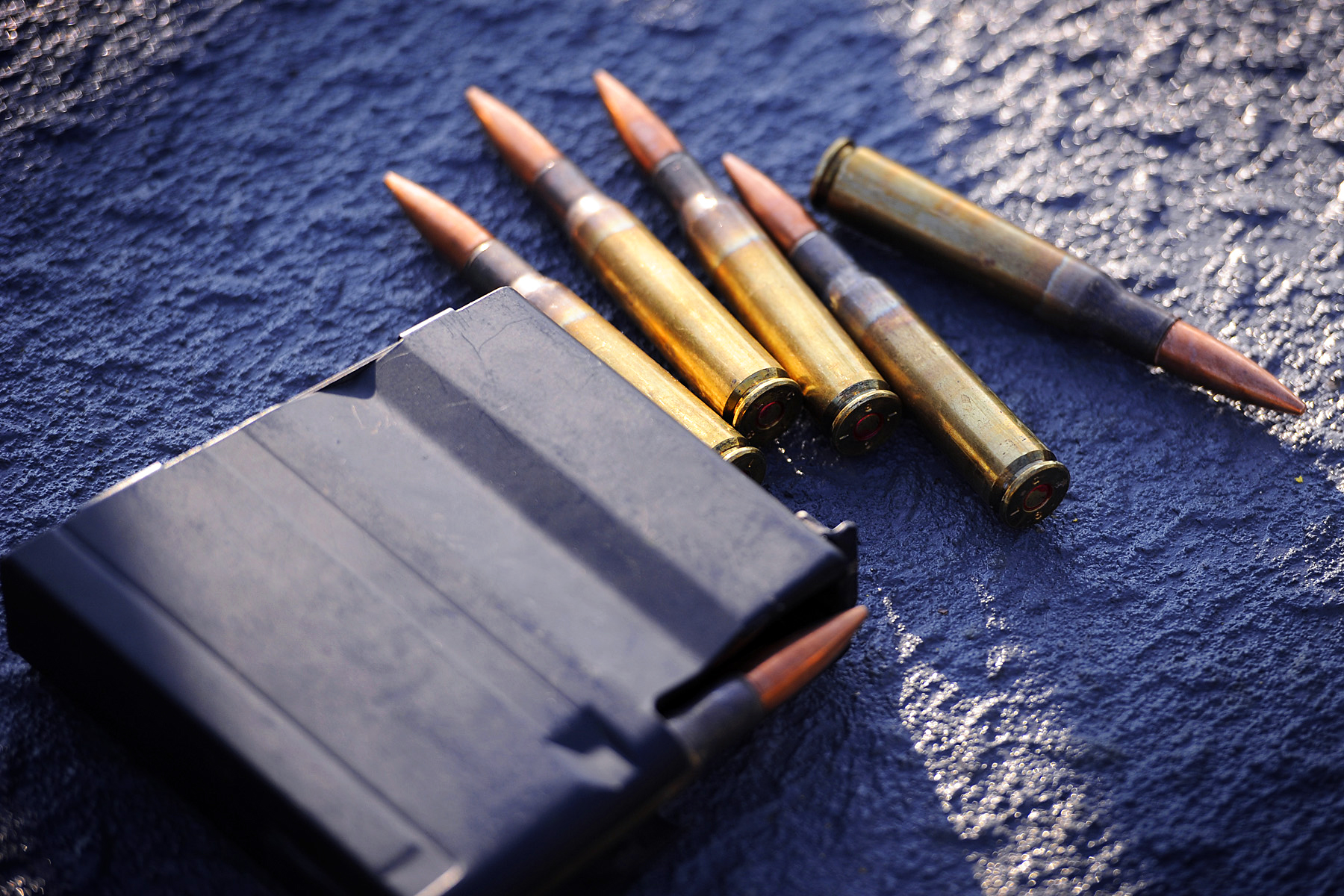
A typical 50 BMG bullet weighs several hundred grains, with common commercial ammunition often falling somewhere around the 600 to 750 grain range. That alone makes it dramatically heavier than the bullets used in most conventional rifle cartridges. But weight is only part of the story.
What makes the 50 BMG particularly interesting is the combination of a very heavy projectile, high velocity and exceptionally efficient bullet designs. A 660 grain ball style load and a 750 grain match load may both say ".50 BMG" on the box, but they can have very different ballistic characteristics and purposes.
That is why understanding 50 BMG ammunition requires looking beyond the sheer size of the cartridge.
First, a 50 BMG Bullet Is Not the Entire Cartridge
There is a terminology issue worth clearing up before going any further.
Technically, the bullet is only the projectile that leaves the barrel. The complete piece of ammunition is a cartridge or round, consisting of the bullet, case, primer and propellant.
In everyday conversation, however, people frequently use "50 BMG bullet" to describe the entire cartridge. Considering how many people search for 50 BMG bullets rather than 50 BMG ammunition, there is little reason to be overly pedantic about it. For this article, we will distinguish between the projectile and complete cartridge whenever that distinction actually matters.
And with 50 BMG, it matters quite a bit.
Two complete cartridges can have essentially the same external dimensions while launching bullets of different weights and designs. Those differences affect velocity, retained energy and performance at distance.
That is where this cartridge becomes much more interesting than its intimidating appearance suggests.
How Big Is a 50 BMG Cartridge?
The 50 BMG is also known by its metric designation, 12.7×99 mm.
Its case is roughly 3.91 inches long, while the complete cartridge is about 5.45 inches in overall length. Bullet diameter is approximately .510 inch. Those dimensions alone put it in a completely different physical category from ordinary sporting rifle ammunition.
The cartridge's size makes more sense when you understand why it exists.
Development traces back to the closing period of World War I. U.S. Army Ordnance wanted a heavy projectile traveling at roughly 2,700 feet per second. Winchester was initially contracted to work on the cartridge, and Frankford Arsenal subsequently continued its development. The resulting 12.7×99 mm cartridge became what we now know as the 50 BMG.
So the cartridge was never designed around the normal priorities of a sporting rifle round. Its enormous case capacity and projectile size came from a very different set of requirements.
More than a century later, that original scale is still immediately apparent.
Put a 50 BMG cartridge next to something like a .308 Winchester and the visual difference is almost comical. But focusing entirely on that size misses what is arguably the most interesting part of the cartridge.
The bullet itself can be remarkably efficient once it is moving.
50 BMG Bullet Weights: There Is More Variation Than You Might Expect
People unfamiliar with 50 BMG ammunition sometimes assume there is essentially one standard bullet. In reality, ammunition exists with a range of projectile weights and designs.
Around 660 grains is closely associated with traditional ball style ammunition. Commercial offerings can vary, while match oriented ammunition frequently uses substantially heavier bullets.
Hornady, for example, offers a 750 grain A Tip Match load. Other commercial and historical examples can fall above or below these figures.
That means there can easily be a difference of nearly 100 grains between two 50 BMG projectiles.
For perspective, an entire common 9mm projectile might weigh 115, 124 or 147 grains. The difference between a 660 grain and 750 grain 50 BMG projectile alone is 90 grains.
Yet this is where looking only at weight can become misleading.
A heavier bullet does not automatically mean a load has greater muzzle velocity. It does not necessarily mean it produces more muzzle energy either. And it certainly does not tell you everything about what happens hundreds of yards away.
For that, we need to compare actual ammunition.
660 Grain vs. 750 Grain 50 BMG: The Numbers Get Interesting
PMC's Bronze 50 BMG load provides a useful example of conventional 660 grain FMJ BT ammunition. PMC publishes a muzzle velocity of approximately 2,950 feet per second from its specified 36 inch test barrel, with muzzle energy around 13,688 foot pounds.
Now compare that with Hornady's much heavier 750 grain A Tip Match load.
Hornady lists the 750 grain load at approximately 2,815 feet per second, also using a 36 inch test barrel, with muzzle energy around 13,196 foot pounds.
At first, that might seem backwards.
The Hornady projectile weighs 90 grains more, yet the lighter PMC load starts faster and carries slightly more published energy at the muzzle.
There is nothing mysterious happening. Kinetic energy depends on both mass and velocity, and velocity has an especially large influence on the calculation. A heavier projectile does not automatically produce greater energy if the lighter projectile is moving sufficiently faster.
This is why comparing ammunition based entirely on bullet weight can lead to bad conclusions.
And once those bullets travel farther downrange, another characteristic starts becoming extremely important.
Ballistic Coefficient Is Where 50 BMG Gets Really Interesting
If size is the characteristic that makes 50 BMG famous, ballistic coefficient is one of the characteristics that makes it fascinating.
Ballistic coefficient, usually abbreviated BC, is a way of expressing how effectively a projectile resists aerodynamic drag. It is not simply a measurement of weight. Bullet shape, diameter, length and other design characteristics matter.
Generally speaking, a projectile with a higher ballistic coefficient loses velocity more slowly and is less affected by aerodynamic drag than a less efficient projectile under comparable conditions.
Some 50 caliber match projectiles have extraordinary ballistic coefficients.
Hornady's ballistic information lists a G1 ballistic coefficient of 1.050 for its 750 grain .50 caliber A MAX projectile. Hornady notes that this projectile was the exception in its referenced bullet line with a ballistic coefficient above 1.0 under the G1 comparison system.
That number is much more important than it may initially appear.
The enormous bullet has considerable mass, but it is also designed to move through the atmosphere efficiently. Instead of simply launching a gigantic piece of metal and watching it rapidly shed velocity, a well designed match projectile can retain a substantial amount of its speed as distance increases.
That is one of the reasons 50 BMG developed such a following among extreme distance target shooters. American Rifleman has similarly highlighted ballistic coefficient as one of the fundamental reasons the cartridge has such strong long range potential.
This is the part of 50 BMG that its physical size doesn't tell you.
The cartridge isn't remarkable simply because the bullet is heavy. It is remarkable because that heavy bullet can also be extremely aerodynamically efficient.
What Happens to a 50 BMG Bullet Farther Downrange?
Muzzle numbers get most of the attention because they are easy to compare. But they only describe the instant when the projectile begins its flight.
Long range ballistics tell us much more.
A projectile begins losing velocity as soon as it encounters aerodynamic drag. How quickly that happens depends heavily on its design and ballistic coefficient, along with atmospheric conditions and other variables.
This is where a high BC 50 caliber match projectile shows its advantage.
Using Hornady's 750 grain match load as an example, its published muzzle velocity is approximately 2,815 fps. At 500 yards, Hornady's data puts the projectile at roughly 2,390 fps, with approximately 9,500 foot pounds of energy remaining.
Think about that for a moment.
After traveling five football fields, the projectile is still moving at a velocity that would be entirely normal as a muzzle velocity for many conventional rifle cartridges.
That does not mean 50 BMG somehow ignores gravity or aerodynamic drag. It certainly does not. The bullet still slows, drops and responds to atmospheric conditions.
What it illustrates is how well an efficient, extremely heavy projectile can preserve momentum and velocity over distance.
And this is why simply comparing muzzle energy between two 50 BMG loads can miss much of what differentiates them.
Heavier Does Not Automatically Mean Better
The 660 versus 750 grain comparison brings us to an important point.
There isn't one universally "best" 50 BMG bullet weight.
A 660 grain FMJ load and a 750 grain match load are not necessarily trying to accomplish exactly the same thing.
A shooter interested primarily in ordinary recreational target shooting may not have the same ammunition priorities as someone pursuing precision at very long distance. Match ammunition places greater emphasis on projectile consistency and aerodynamic performance, while more conventional ammunition may make sense when that level of precision is unnecessary.
That distinction exists in smaller rifle cartridges too, but 50 BMG makes it especially noticeable because the numbers are so extreme.
It is tempting to look at two boxes, see 660 grains and 750 grains, and conclude that 750 must simply be the more powerful choice.
The manufacturer's published numbers demonstrate why that assumption doesn't work.
The lighter 660 grain PMC example starts faster and actually produces slightly greater published muzzle energy than the heavier Hornady load. The heavier Hornady projectile, meanwhile, is specifically engineered around match performance and aerodynamic efficiency.
Different priorities produce different ammunition.
Ball Ammo and Match Ammo Are Not the Same Thing
This also explains why the words printed after ".50 BMG" on a box matter.
FMJ ball style ammunition represents one familiar category. Match ammunition represents another. Commercial offerings may use different projectile designs, weights and construction depending on their intended purpose.
For a recreational shooter, ordinary ammunition can make sense when the goal is simply putting rounds on a target and experiencing the cartridge.
Precision shooters have different priorities.
Small variations in projectile shape, consistency and aerodynamic performance become increasingly significant as distance grows. A difference that seems insignificant at short range can become much more apparent after hundreds of yards of flight.
That is why premium match ammunition exists even for a cartridge that already produces extraordinary raw ballistic numbers.
Power and precision are not the same thing.
A cartridge can produce enormous muzzle energy without necessarily being optimized for the smallest possible groups at extreme distance.
This is one of the most useful things to understand when comparing 50 BMG ammunition. Don't assume every box containing a similarly weighted giant projectile is interchangeable in purpose.
Why 50 BMG Has Such Extreme Energy
There is no getting around the raw energy numbers.
Historical and commercial 50 BMG ammunition commonly produces muzzle energy measured well into five figures. American Rifleman has described the cartridge as producing roughly 12,000 to 14,000 foot pounds depending on the load.
Compare that with conventional centerfire rifle ammunition and the scale becomes obvious very quickly.
But again, projectile weight alone isn't responsible.
Energy is the result of getting hundreds of grains of projectile moving at rifle velocities. That requires a very large cartridge case and a substantial amount of propellant compared with ordinary sporting ammunition.
The result is a combination that relatively few cartridges can match: a projectile weighing well over half a thousand grains traveling somewhere around the upper 2,000 fps range in many conventional loads.
That's why 50 BMG numbers sometimes look like typographical errors to shooters accustomed to normal rifle ammunition.
They aren't.
It really does operate on a different scale.
Does That Mean 50 BMG Shoots Flat?
This is another place where terminology can cause confusion.
People often describe powerful cartridges as "flat shooting," but gravity affects every projectile. A 50 BMG bullet begins falling as soon as it leaves the barrel just like any other bullet.
What helps a good 50 caliber match projectile is its ability to retain velocity.
Less velocity lost to aerodynamic drag means the projectile can maintain a favorable trajectory over distance compared with a less efficient projectile under otherwise similar circumstances.
A high ballistic coefficient can also reduce the amount of wind deflection relative to a less efficient projectile.
But trajectory depends on much more than the cartridge name.
Bullet, muzzle velocity, ballistic coefficient, sight height, zero distance, altitude, temperature and atmospheric conditions can all influence the result.
That's why generic claims such as "a 50 BMG drops exactly X inches at 1,000 yards" aren't particularly useful without specifying the ammunition and conditions.
There is no single 50 BMG trajectory. There are trajectories for individual 50 BMG loads under specific conditions.
That distinction matters.
What Is 50 BMG Actually Good For?
The cartridge's origins are military, and that history is inseparable from its development. But civilian interest in 50 BMG is largely a different story.
Today, one of its most interesting sporting applications is long range target shooting.
The combination of enormous projectile mass, high velocity and very high ballistic coefficients gives precision oriented 50 BMG ammunition unusual capabilities at extended distances.
American Rifleman has described long range target shooting as a major source of the cartridge's civilian appeal.
There is also a simpler reason people shoot it:
50 BMG is an experience.
Most shooters can spend their entire lives around firearms without encountering another commonly available cartridge quite like it. The ammunition is huge. The rifles are huge. The recoil and muzzle blast are substantial. Even handling one of the cartridges makes ordinary rifle ammunition suddenly look small.
That novelty is part of the appeal.
But for shooters who pursue serious long range precision, the cartridge offers more than spectacle. Its projectile design and retained ballistic performance give it capabilities that explain why it continues to interest long distance competitors and enthusiasts decades after entering the civilian shooting world.
Why Is 50 BMG Ammo So Expensive?
Pick up a 50 BMG cartridge and part of the answer becomes immediately obvious.
There is simply a lot of material in each round.
The case is enormous compared with ordinary rifle brass. The projectile may weigh 600, 700 or even 750 grains or more. The cartridge also requires substantially more propellant than typical sporting ammunition.
Then consider the market.
50 BMG isn't produced and consumed on the same civilian scale as cartridges such as 9mm, .223 Remington, 5.56 NATO or .308 Winchester. Specialized match ammunition can add another layer of manufacturing precision and projectile cost.
All of that contributes to ammunition that is expensive on a per round basis.
It also means the difference between ammunition types matters more financially. Buying the wrong ammunition for what you're actually trying to accomplish can become expensive very quickly.
50 BMG vs. Ordinary Rifle Ammunition
Calling 50 BMG a "large rifle cartridge" almost understates the difference.
A conventional rifle cartridge might launch a projectile weighing somewhere around 50 to 200 grains depending on the caliber and application. The 50 BMG routinely deals with projectiles several times heavier while still achieving substantial rifle velocities.
The physical dimensions reflect that difference too.
At roughly 5.45 inches in overall cartridge length, a single 50 BMG round is enormous compared with the ammunition most shooters regularly handle.
But the biggest distinction is not one measurement.
It is the combination.
Heavy projectile. High velocity. Huge energy. High ballistic coefficient. Exceptional retained performance.
Take away any one of those characteristics and the cartridge becomes less remarkable.
Put them together and you begin to understand why the 50 BMG has remained relevant for more than a century.
Is a 750 Grain 50 BMG Better Than a 660 Grain?
Not automatically.
If there's one takeaway from this article worth remembering, this may be it.
Bullet weight is only one variable.
The 750 grain Hornady match example is designed around precision and aerodynamic efficiency. The 660 grain PMC FMJ example is a different type of ammunition with different priorities.
Their published muzzle numbers alone demonstrate why simply choosing the heavier projectile doesn't answer the question.
PMC's lighter 660 grain example starts faster and produces slightly greater published muzzle energy. Hornady's heavier match projectile brings an exceptionally high ballistic coefficient and a design intended for precision.
Which characteristic matters more depends on what you expect from the ammunition.
For ordinary recreational target shooting, paying for premium match ammunition may offer little practical benefit to some shooters. For precision work at significant distance, projectile consistency and ballistic coefficient become much more important.
The box still says 50 BMG either way.
What's inside can be very different.
The Most Interesting Thing About 50 BMG Isn't Its Size
The size is what everyone notices first.
That's understandable.
A 50 BMG cartridge looks enormous even to people who spend a lot of time around ammunition. Its projectile can weigh several times as much as an entire conventional rifle bullet, and its muzzle energy reaches figures that make ordinary sporting cartridges seem modest.
But size isn't what makes the cartridge truly interesting.
The fascinating part is what happens after that massive bullet begins moving.
A carefully designed 50 caliber projectile can combine hundreds of grains of mass with very high velocity and extraordinary aerodynamic efficiency. Match projectiles can carry impressive velocity and energy far downrange. Different bullet weights can produce counterintuitive muzzle energy figures. And two cartridges that look almost identical at first glance can be designed for very different purposes.
That is the lesson hidden behind all those enormous numbers.
50 BMG isn't remarkable simply because somebody built a gigantic cartridge. It is remarkable because that gigantic cartridge can launch an exceptionally efficient projectile at serious rifle velocity.
More than a century after its development began, that's still an extraordinary combination.
Disclaimer
Information provided by AmmoBrowser is for general informational and educational purposes only. Ammunition specifications, ballistics, performance, pricing, and availability can vary by manufacturer, load, firearm, barrel length, and other conditions. While we strive to provide accurate and current information, AmmoBrowser makes no guarantee regarding its completeness or accuracy. Always follow firearm and ammunition manufacturer instructions, verify that ammunition is compatible with your firearm, and follow all applicable laws and safe firearm handling practices.