
 Wishlist

Walk into almost any ammunition store, and you'll find two very different types of cartridges sitting on the shelves. On one side are familiar rimfire rounds like .22 LR, known for affordable shooting, mild recoil, and countless afternoons spent at the range. On the other are centerfire cartridges such as 9mm, .223 Remington, and .308 Winchester, covering everything from recreational handgun shooting to long-range rifle competitions and big-game hunting.
At first glance, the difference might seem insignificant. Both types of ammunition contain a projectile, propellant, and a system for igniting that propellant. Both operate on the same basic principle of rapidly expanding gases pushing a projectile down a barrel. Yet one small difference in cartridge construction has shaped how ammunition is manufactured, how much it costs, and what different cartridges are capable of doing.
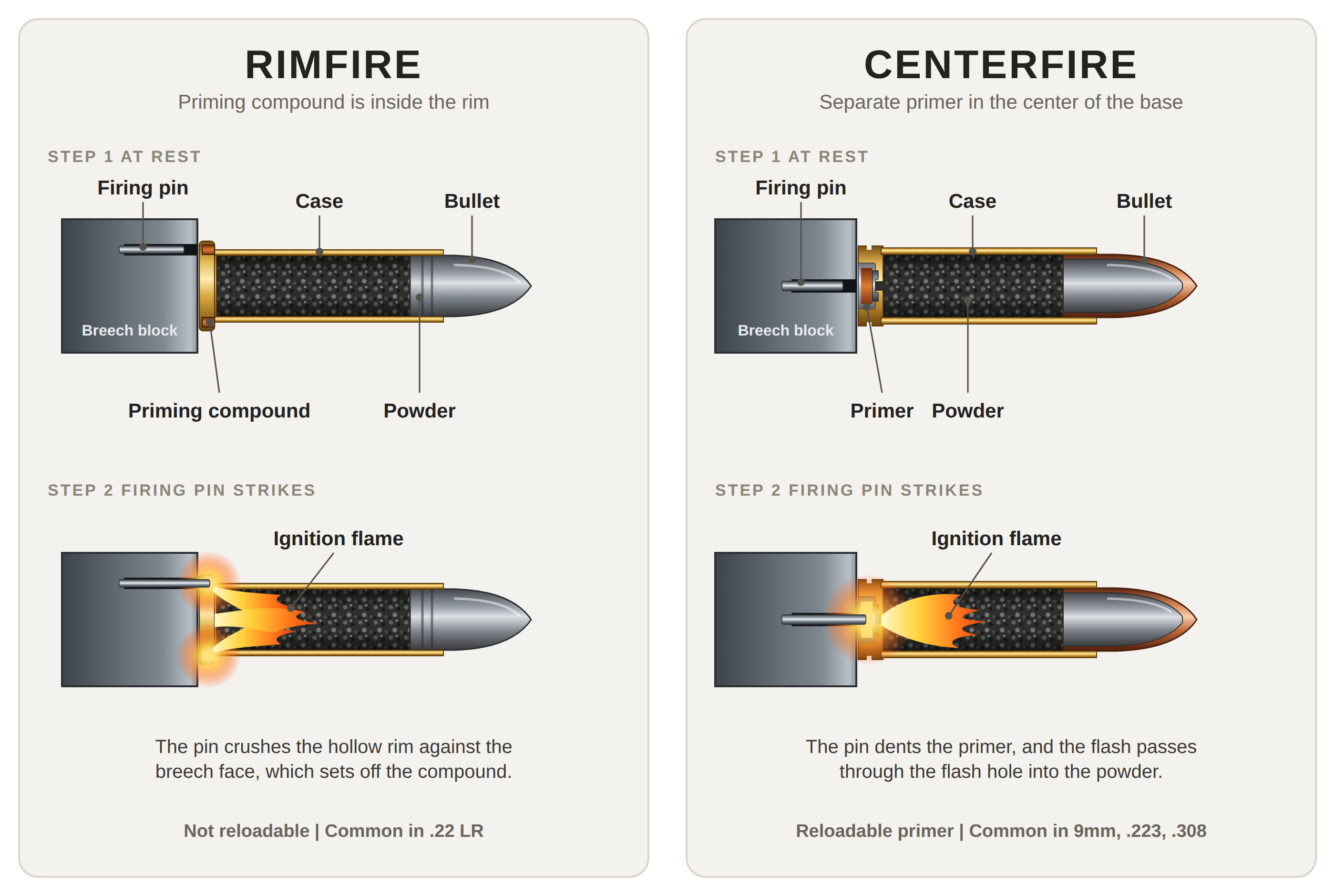
The distinction comes down to where the primer is located. Rimfire ammunition contains its priming compound inside the rim of the cartridge case, while centerfire ammunition uses a separate primer positioned in the center of the case head. That difference influences everything from reliability and reloading to cartridge strength and manufacturing costs.
So, is centerfire ammunition actually better, or does rimfire have advantages that make it worth choosing? The answer depends on what you're shooting, how often you visit the range, and what you expect from your ammunition.
Quick Answer: What's the Difference Between Rimfire and Centerfire?
The biggest difference between rimfire and centerfire ammunition is how each cartridge ignites. Rimfire ammunition uses a priming compound distributed inside the hollow rim of its case. When the firing pin strikes and crushes the rim, the compound ignites the propellant. Centerfire ammunition uses a separate primer seated in the middle of the cartridge base, where the firing pin strikes it directly.
That simple difference leads to several practical advantages and disadvantages. Rimfire ammunition, particularly .22 LR, is generally less expensive, produces little recoil, and is well suited for recreational shooting, beginner instruction, and small-game hunting. Centerfire ammunition generally offers more reliable ignition, stronger cartridge construction, a much wider range of power levels, and the ability to reload many fired cases.
Neither system is universally better. Rimfire makes frequent shooting affordable and accessible, while centerfire supports a broader range of firearms and applications. Many experienced shooters regularly use both because each fills a different role.
What Is Rimfire Ammo, and How Does It Work?
Rimfire ammunition gets its name from the location of its priming compound. Instead of using a separate primer inserted into the base of the cartridge, a rimfire case contains priming material inside its hollow outer rim. During manufacturing, the compound is distributed around the interior of that rim so it can ignite when struck by the firearm's firing pin.
When a rimfire firearm is discharged, its firing pin strikes the edge of the cartridge base rather than the center. The impact crushes part of the thin rim against the chamber, initiating the priming compound. This ignites the propellant inside the case, creating expanding gases that push the bullet through the barrel.
The design is relatively simple, and that simplicity helps explain why rimfire ammunition has remained popular for generations. Manufacturers do not need to install a separate primer assembly, reducing some of the components and manufacturing steps associated with centerfire cartridges. For small cartridges produced in enormous quantities, those savings can make a meaningful difference in retail price.
However, rimfire construction also introduces limitations. The cartridge rim must be thin and soft enough for the firing pin to crush it reliably. That requirement restricts how strong the case can be and helps explain why modern rimfire ammunition is concentrated in relatively small, lower-pressure cartridges rather than powerful hunting rifle rounds.
The most recognizable example is the .22 Long Rifle, commonly called .22 LR. It has become a favorite for inexpensive target practice, recreational shooting, and small-game hunting. Other familiar rimfire cartridges include .22 Winchester Magnum Rimfire, commonly called .22 WMR or .22 Mag, and .17 Hornady Magnum Rimfire, better known as .17 HMR. These cartridges offer different velocities and trajectories, but all use the same basic rimfire ignition principle.
The important point is that rimfire ammunition is not defined solely by low velocity or small bullets. It is defined by its ignition system. The mild recoil and low cost commonly associated with rimfire shooting are largely characteristics of popular cartridges such as .22 LR, rather than automatic results of where the primer is located.
What Is Centerfire Ammo, and Why Is It So Common?
Centerfire ammunition uses a different approach to ignition. Instead of distributing priming compound around the cartridge rim, manufacturers install a separate primer in a pocket at the center of the case head. When the firearm's firing pin strikes that primer, the priming compound ignites and sends a flame through the primer flash hole to ignite the propellant.
This design allows the cartridge case to be built without the thin, crushable rim required by rimfire ammunition. Centerfire cases can therefore be engineered to withstand a much broader range of chamber pressures, making the system suitable for everything from relatively mild handgun cartridges to powerful magnum rifle ammunition.
That versatility explains why centerfire ignition dominates modern handgun, rifle, and shotgun ammunition. Common handgun cartridges such as 9mm Luger, .45 ACP, .38 Special, and 10mm Auto all use centerfire primers. Popular rifle cartridges including .223 Remington, 5.56 NATO, .308 Winchester, .30-06 Springfield, and 6.5 Creedmoor also rely on centerfire ignition. Most modern shotshells, including 12-gauge and 20-gauge ammunition, use centerfire primers as well.
Another major advantage is that many centerfire cartridge cases can be reloaded. After firing, a suitable brass case can often be inspected, resized, fitted with a new primer, and reloaded with the appropriate components by a knowledgeable reloader following established published data. That process is not practical with ordinary fired rimfire cases because the priming compound is integrated into the case rim and the firing pin permanently deforms part of that rim.
Centerfire ammunition is generally more expensive to manufacture than small rimfire ammunition because its construction requires additional components and manufacturing steps. However, the difference in price is not simply about primer location. Cartridge size, materials, production volume, bullet construction, and market demand all affect the final cost.
Centerfire's greatest strength is flexibility. The same general ignition system supports ammunition for affordable range practice, competitive shooting, hunting, and specialized applications. That broad range of performance is something modern rimfire ammunition cannot match.
Rimfire vs Centerfire: Cost, Reliability, Accuracy, and Recoil
Understanding the mechanical difference is useful, but most shooters want to know how it affects their experience at the range. The practical differences between rimfire and centerfire become especially clear when comparing ammunition costs, ignition reliability, recoil, and accuracy.
Ammunition Cost: Why Rimfire Usually Wins
Price is arguably rimfire ammunition's greatest advantage. A box of .22 LR generally costs considerably less than the same number of rounds of popular centerfire ammunition such as 9mm or .223 Remington. For someone who shoots regularly, that difference adds up quickly. A shooter who practices with hundreds of rounds each month may spend substantially less using .22 LR than a centerfire cartridge.
The manufacturing process is part of the reason. Rimfire cartridges avoid the separate primer assembly used in centerfire ammunition, and popular rimfire rounds are small, use relatively little material, and are manufactured in large quantities. Those characteristics help manufacturers keep production costs down.
Centerfire ammunition involves a wider range of costs because the cartridges themselves vary enormously. Affordable 9mm practice ammunition is a completely different product from premium .300 Winchester Magnum hunting ammunition, even though both use centerfire primers. Larger cases, specialized projectiles, higher material costs, and smaller production volumes can all increase the price.
For recreational shooters, the difference often comes down to cost per round. A .22 LR firearm can provide hours of affordable practice without the expense associated with firing the same number of centerfire rounds. Centerfire ammunition may still be necessary for training with a particular firearm or competing in a specific discipline, but rimfire offers an economical way to spend more time developing shooting fundamentals.
Reliability: Why Centerfire Has the Advantage
Centerfire ammunition generally offers more consistent ignition than rimfire ammunition. Its separate primer is designed to respond to a direct firing-pin strike, while rimfire ignition depends on the priming compound being distributed properly within the cartridge rim and the firing pin crushing the rim effectively.
A rimfire cartridge may fail to ignite if the firing pin strikes a portion of the rim where the priming compound is insufficiently distributed. Manufacturing quality has improved considerably over time, and good rimfire ammunition can be dependable, but occasional misfires remain a familiar characteristic of the design.
Centerfire ammunition is not immune to failures. Defective primers, improper storage, ammunition damage, and firearm-related problems can all cause a centerfire round to malfunction. Still, modern centerfire primers generally provide a reliability advantage, particularly in applications where consistent ignition is especially important.
This does not mean every rimfire malfunction comes from a defective cartridge. Feeding problems, extraction issues, magazine condition, and firearm maintenance can also affect reliability. Some rimfire firearms are sensitive to particular ammunition brands or bullet shapes, just as certain centerfire firearms can be.
For general recreational shooting, an occasional ammunition malfunction may be an inconvenience. In applications where reliability is a critical requirement, the centerfire ignition system's consistency is a significant advantage.
Accuracy: Is Centerfire Actually More Accurate?
One of the biggest misconceptions about rimfire ammunition is that it is inherently less accurate than centerfire ammunition. That simply isn't true. Both types can deliver excellent accuracy, and rimfire rifles are used in serious precision competitions where tiny differences in group size matter.
Accuracy depends on much more than primer location. Barrel quality, ammunition consistency, bullet design, chamber dimensions, environmental conditions, and shooter technique all contribute to where a projectile lands. A well-built .22 LR target rifle firing carefully selected ammunition can produce impressive groups, while a poorly matched centerfire rifle and ammunition combination may struggle to deliver consistent results.
The difference becomes more noticeable as shooting distances increase. Popular rimfire cartridges generally fire lighter bullets at lower velocities than many centerfire rifle cartridges, making them more susceptible to bullet drop and wind drift over longer distances. That can make distant targets more challenging even when the rifle and ammunition are mechanically accurate.
Centerfire rifle cartridges offer a much wider selection of high-ballistic-coefficient bullets and higher-velocity loads designed for long-distance shooting. This gives centerfire ammunition a significant advantage for applications where flatter trajectories, reduced wind drift, and substantial downrange energy are important.
However, rimfire's more challenging trajectory can also make it an excellent training tool. Shooters practicing with .22 LR at moderate distances can learn to understand wind, distance, and consistent shooting technique without the expense of high-volume centerfire rifle practice.
The conclusion is straightforward: centerfire ammunition generally offers greater long-range performance potential, but rimfire ammunition is not inherently inaccurate.
Recoil and Noise: Why Rimfire Is Easier to Shoot
One reason .22 LR remains so popular is its mild recoil. Many shooters can fire a rimfire rifle or pistol for extended periods without experiencing the same fatigue associated with more powerful centerfire cartridges. The reduced recoil also makes it easier to concentrate on sight alignment, trigger control, and follow-through.
This is particularly valuable for people learning to shoot. When recoil is mild, beginners can focus on developing consistent habits rather than anticipating the movement of the firearm. Experienced shooters also benefit because inexpensive, low-recoil practice provides an opportunity to reinforce fundamentals.
Rimfire ammunition is often quieter than common centerfire ammunition, although the difference varies by cartridge, barrel length, and load. A standard .22 LR round produces a different shooting experience from a .308 Winchester rifle cartridge, but that does not mean rimfire ammunition is harmless to hearing. Even small rimfire cartridges can generate dangerous noise levels, and appropriate hearing protection should always be used.
It is also important to understand that recoil is not determined by ignition type alone. Bullet weight, velocity, firearm weight, propellant charge, and firearm design all influence felt recoil. A relatively mild centerfire cartridge can be comfortable to shoot, while a lightweight rimfire firearm chambered for a faster cartridge may feel noticeably different from a heavy .22 LR target rifle.
For affordable practice with minimal recoil, common rimfire cartridges have a clear advantage. For shooters who need the performance of larger cartridges, centerfire ammunition offers capabilities that generally come with greater recoil and noise.
Why Is Rimfire Ammo Still So Popular?
With centerfire ammunition offering greater cartridge strength, more consistent ignition, and broader performance options, it might seem surprising that rimfire ammunition remains so widely used. The explanation is simple: rimfire excels at activities where centerfire's additional capabilities are not necessary.
The .22 LR is one of the best examples. It provides a relatively inexpensive way to practice shooting fundamentals, introduce new shooters to the sport, and enjoy recreational target shooting. Its mild recoil makes it approachable, while the variety of available firearms allows shooters to choose everything from simple bolt-action rifles to specialized competition pistols and precision rimfire rifles.
Rimfire ammunition also serves a useful role in small-game hunting. Cartridges such as .22 LR, .22 WMR, and .17 HMR offer different combinations of velocity and trajectory suitable for appropriate small-game and varmint applications, subject to local regulations. Their relatively modest performance can be an advantage when a larger centerfire cartridge would be unnecessary.
Perhaps the most overlooked advantage is that rimfire makes shooting more accessible over time. Someone who can afford to practice regularly is likely to gain more experience than someone whose ammunition budget limits every range session. That doesn't make rimfire a complete substitute for training with a centerfire firearm, but it does make it a valuable part of many shooters' routines.
Rimfire's popularity is not evidence that it competes with centerfire in every category. It remains popular because affordable ammunition, manageable recoil, and enjoyable shooting are valuable characteristics in their own right.
Rimfire vs Centerfire for Hunting, Target Shooting, and Everyday Use
The best ammunition type depends heavily on the activity. Rimfire and centerfire cartridges overlap in some applications, but they are not interchangeable, and each offers advantages in different situations.
For recreational target shooting, rimfire is difficult to beat on cost. A .22 LR rifle can provide an enjoyable afternoon at the range without requiring a large ammunition budget. Rimfire is also used in organized competitions, including precision rifle events that challenge shooters with small targets, wind, and varying distances.
Centerfire ammunition becomes more important when the activity requires a specific cartridge, higher levels of energy, or greater long-range performance. Handgun competitions commonly use centerfire cartridges such as 9mm, while long-range rifle competitions frequently rely on cartridges designed to retain velocity and resist wind drift at extended distances.
Hunting provides another clear distinction. Rimfire cartridges are commonly associated with small game and varmints, while centerfire rifle ammunition offers the wider range of bullet weights, energy levels, and projectile designs needed for many larger game animals. A .22 LR and a .308 Winchester serve very different purposes, even though both are familiar rifle cartridges. Hunting regulations also frequently restrict which ammunition types may be used for particular species, so legal requirements must always be checked.
For personal-defense applications, centerfire ammunition is generally favored because of its broader cartridge selection, more consistent ignition, and availability of purpose-designed ammunition. That does not make rimfire firearms harmless or incapable of causing serious injury, but it does help explain why centerfire cartridges dominate that category.
For many shooters, the most practical answer is to own firearms that use both ammunition types. Rimfire can provide economical practice and recreational enjoyment, while centerfire firearms cover applications that demand different performance characteristics.
Can You Reload Rimfire and Centerfire Ammo?
Reloading is another major difference between these two cartridge designs. Many centerfire cartridges use brass cases that can be reused after firing, provided they remain in suitable condition. Their separate primers can be removed and replaced as part of a properly conducted reloading process.
For people who shoot large quantities of centerfire ammunition, reloading can offer greater control over ammunition selection and, in some circumstances, lower costs. However, savings depend on equipment, component prices, time, and the particular cartridge. Reloading also requires specialized knowledge and strict adherence to published safety procedures.
Ordinary rimfire cases are not practically reloadable using conventional methods. The priming compound is contained within the rim itself, and the firing pin deforms that rim when the cartridge is fired. Unlike a centerfire case, there is no separate spent primer that can simply be replaced.
Although unusual experimental methods exist, they are not a practical or recommended substitute for factory rimfire ammunition. For most shooters, the inexpensive cost of .22 LR makes purchasing new cartridges far more sensible than attempting to reuse fired cases.
Reloading is therefore a meaningful advantage of centerfire ammunition, especially for enthusiasts who shoot cartridges that are relatively expensive or difficult to find.
How to Tell Rimfire and Centerfire Ammo Apart
Fortunately, distinguishing the two designs is usually straightforward when looking at the base of an unfired cartridge.
A typical rimfire cartridge has a relatively plain case head with no separate circular primer visible in the center. Its priming compound is concealed inside the outer rim, so there is no distinct primer cup to identify from the outside. On a fired rimfire case, the firing pin usually leaves a small indentation along the edge.
A centerfire cartridge generally has a clearly visible circular primer seated in the middle of the case head. The primer may be a slightly different color from the surrounding brass, making it easy to recognize. After firing, the firing pin normally leaves an indentation in the center of that primer.
Cartridge size alone is not a reliable way to identify the ignition system. Although many rimfire cartridges are small, there are also relatively small centerfire cartridges. Likewise, not every centerfire cartridge is large or powerful.
The most important consideration is firearm compatibility. Rimfire and centerfire ammunition cannot be substituted simply because cartridges appear similar in size. Always use the exact ammunition specified by the firearm manufacturer and verify the cartridge designation before loading.
Rimfire vs Centerfire: Which One Should You Choose?
For someone primarily interested in affordable range practice, recreational shooting, or learning firearm fundamentals, rimfire ammunition is an excellent option. A .22 LR firearm provides manageable recoil, widely available ammunition, and the opportunity to practice frequently without the cost associated with many centerfire cartridges.
For shooters interested in centerfire handgun practice, larger-game hunting, or long-distance rifle shooting, centerfire ammunition provides the performance and versatility those activities often require. Its ignition system supports stronger cases, a broader selection of cartridges, and generally more consistent ignition.
Accuracy alone should not determine the decision. Both rimfire and centerfire firearms can be highly accurate within their intended roles. Similarly, ammunition price should be considered alongside the activity rather than treated as the only deciding factor.
If you already own a firearm, the choice is even simpler: use only the cartridge specified for that firearm. Rimfire and centerfire are descriptions of ignition systems, not alternative ammunition options that can be freely substituted.
Whether you're shopping for affordable .22 LR practice ammunition or centerfire rounds for your next range trip, comparing prices can help keep shooting costs under control. AmmoBrowser lets you compare current ammunition prices from online retailers so you can find options that fit your needs and budget.
Final Thoughts: Two Designs, Two Different Strengths
The difference between rimfire and centerfire ammunition begins with something as small as primer placement, but its influence extends throughout the shooting world. Rimfire's simple construction makes small cartridges affordable and accessible, while centerfire's separate primer and stronger case design support a much wider range of ammunition performance.
Rimfire has earned its place through low cost, mild recoil, and its usefulness for recreational shooting, training, and small-game hunting. Centerfire has become the standard for most modern handgun and rifle applications because of its versatility, ignition reliability, and ability to accommodate more demanding cartridges.
Neither design makes the other obsolete. In fact, their differences explain why both have remained relevant for so long. A shooter enjoying an afternoon with a .22 LR rifle and another practicing with a centerfire handgun are using two different ammunition technologies, each well suited to its intended purpose.
Ultimately, the better choice isn't determined by which primer system is more advanced. It's determined by what you want your ammunition to accomplish. Understanding those differences makes it easier to choose the right cartridge, recognize its limitations, and appreciate why rimfire and centerfire continue to serve different roles.
This article is intended for general educational purposes. Always use ammunition that matches the exact cartridge designation specified by your firearm manufacturer. Follow established firearm safety rules, wear appropriate eye and hearing protection, and consult a qualified firearms instructor when learning to shoot. Reloading ammunition requires specialized knowledge, appropriate equipment, and strict adherence to published safety procedures. Always follow applicable local, state, and federal laws.